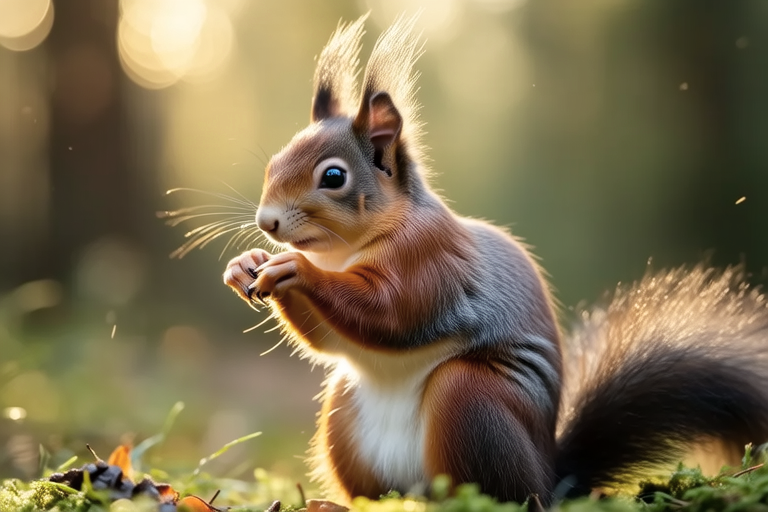
The Secret Language of Squirrels: What Their Chatter Means
Squirrels, those ubiquitous creatures darting through parks and backyards, are not just cute animals with bushy tails. They are highly social beings that rely heavily on vocalizations and body language to communicate. Understanding the secret language of squirrels can provide fascinating insights into their behavior and the world they inhabit.
Vocalizations and Body Language: The Foundation of Squirrel Communication
Like many other mammals, squirrels use both vocalizations and body language to convey messages. These methods allow them to interact effectively within their complex social structures. Vocalizations are particularly important for long-distance communication, while body language helps with close-range interactions. Squirrels produce a variety of sounds, including chatters, barks, and whines, each serving specific purposes.
Diverse Calls: Alarm Calls, Mating Calls, and Territorial Disputes
One of the most common vocalizations among squirrels is the alarm call. This sharp, high-pitched sound serves as a warning to fellow squirrels about potential threats, such as predators or humans. When a squirrel spots danger, it will emit a series of rapid, staccato-like chirps, alerting others to the presence of a threat. For instance, if a hawk swoops down, the alarmed squirrel might make a loud ‘kuk-kuk-kuk’ sound to signal its companions.
Mating calls are another significant form of vocalization. During breeding season, male squirrels produce distinctive calls to attract female partners. These calls are often softer and more melodic compared to alarm calls. They serve to establish dominance and interest in potential mates. For example, the eastern gray squirrel produces a soft, warbling song during the spring mating season to attract females.
Territorial disputes also involve vocalizations. Squirrels are territorial and often engage in conflicts over food sources, nesting sites, and mates. In these situations, they produce aggressive vocalizations to assert their dominance. These sounds can range from growls to harsh barks, depending on the intensity of the dispute. For instance, two red squirrels may engage in a prolonged series of barks and growls when fighting over a prime nesting spot.
Species-Specific Communication: Differences Among Squirrels
While many communication patterns are shared across squirrel species, there are also notable differences. The red squirrel, for example, is known for its distinctive ‘brrr-r-r-r-rup’ call, which it uses to communicate with other red squirrels. This call is often associated with territorial defense and can be heard throughout the forest. In contrast, the eastern gray squirrel produces a more varied repertoire of calls, including chirps, trills, and barks. Each species has adapted its communication strategies to suit its particular ecological niche.
The California ground squirrel, found in western North America, has a unique way of communicating. It uses tail-flagging, a behavior where it rapidly waves its tail side-to-side, to signal alarm and deter predators. This visual cue is often accompanied by a series of sharp barks, creating a multi-modal communication system. This combination of visual and auditory signals is particularly effective in warning other squirrels about the presence of a predator.
Recent Studies on Squirrel Communication
Researchers have been studying squirrel communication for decades, and recent studies have provided valuable insights into the complexity of their vocalizations. One study conducted at the University of California, Berkeley, focused on the alarm calls of the fox squirrel. Researchers found that these squirrels can differentiate between aerial and terrestrial predators based on the structure of their alarm calls. Aerial predator calls were shorter and higher-pitched, while terrestrial predator calls were longer and lower-pitched. This suggests that squirrels can tailor their communication to the specific threat they face.
Another study, published in the journal Animal Behavior, explored the use of scent marking in red squirrels. Scientists discovered that red squirrels use scent marks to advertise their territories and to attract mates. These scent marks contain chemical signals that convey information about the squirrel’s identity, sex, and reproductive status. This study highlights the importance of olfactory communication in squirrel societies.
Observing and Interpreting Squirrel Chatter
For those interested in observing and interpreting squirrel chatter, there are several tips to keep in mind. First, it’s essential to familiarize yourself with the different types of vocalizations and their meanings. Spend time in your local park or backyard, listening to the various sounds squirrels make. Over time, you’ll begin to recognize the distinct alarm calls, mating songs, and territorial disputes.
Body language is equally important. Pay attention to how squirrels move their tails, posture themselves, and interact with one another. Tail-flagging, for example, is a clear sign of alarm, while nose-touching may indicate friendly interaction or courtship behavior. By combining your knowledge of vocalizations and body language, you can gain a deeper understanding of the secret language of squirrels.
It’s also helpful to observe squirrels in different contexts. For instance, pay attention to how they behave during mating season, when food is scarce, or when a predator is nearby. These variations in behavior will give you a broader perspective on their communication patterns. Additionally, consider keeping a journal of your observations, noting the date, time, location, and details of the interactions you witness. This will help you track changes in squirrel behavior over time and deepen your understanding of their secret language.
In conclusion, the secret language of squirrels is a rich and intricate system of vocalizations and body language. From alarm calls to mating songs and territorial disputes, each sound and gesture provides valuable information about the squirrels’ behavior and environment. By observing and interpreting squirrel chatter, we can gain a greater appreciation for these fascinating creatures and the complex world they inhabit. So next time you see a squirrel scurrying through the park, take a moment to listen closely. You might just catch a glimpse of their secret language.
